Firestopping, Made Simple: How to Keep Fire & Smoke Where They Belong
Firestopping, Made Simple: How to Keep Fire & Smoke Where They Belong
Short version: Firestopping is passive fire protection that keeps fire and smoke from moving through rated walls, floors, and ceilings via penetrations and joints. To pass inspection the first time, you must use the correct tested system (e.g., UL), install it exactly as specified, and document it.
What Firestopping Is (and Isn’t)
What Firestopping Is (and Isn’t)
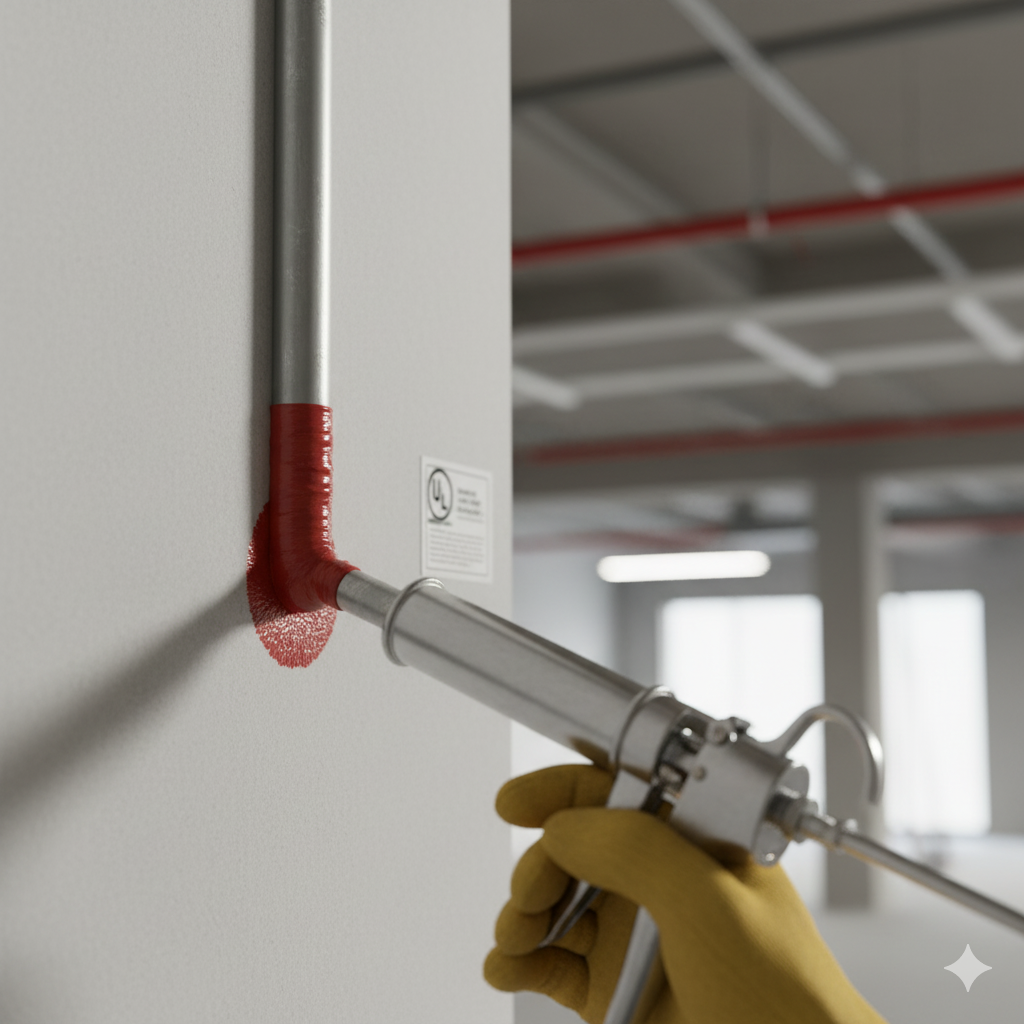
Is: A tested combination of materials—mineral wool, intumescent collars/wraps, sealants, mortars—installed so the barrier keeps its rating after a pipe, cable, or duct passes through.
Isn’t: “Red caulk everywhere.” If the pipe diameter, material, substrate, or bead thickness differs from the tested system, the installation can fail and be rejected.
Where You Need It
Where You Need It
MEP penetrations: pipes, conduits, cable trays through rated walls/floors.
Head-of-wall joints: where partitions meet slab/deck.
Shafts & risers: vertical services and chase walls.
Ducts & dampers: maintain rating continuity around duct openings and ensure fire/smoke dampers remain accessible and properly sealed.
Tested Systems: Your Ticket to First-Time Approval
Tested Systems: Your Ticket to First-Time Approval
A tested (UL) system defines everything: barrier type (gypsum/masonry/slab), penetration material/diameter, packing (e.g., mineral wool), sealant type and thickness, required devices (collars/wraps), and even which side they go on.
Change the variables, change the system. Select the exact match before installation, then label and photograph each condition.
Common Reasons Projects Fail Inspection (and Fixes)
Using generic sealant with no tested system → Select the correct UL design per condition.
Skipping mineral wool backing where required → Install to the specified density/depth.
Collars on the wrong side or with too few anchors → Follow the diagram precisely.
Gaps, dirty edges, sloppy beads → Prep substrates, tool clean beads, verify thickness.
No labels or photos → Label each penetration/joint and document before/after.
An AHJ-Friendly Workflow
Using generic sealant with no tested system → Select the correct UL design per condition.
Skipping mineral wool backing where required → Install to the specified density/depth.
Collars on the wrong side or with too few anchors → Follow the diagram precisely.
Gaps, dirty edges, sloppy beads → Prep substrates, tool clean beads, verify thickness.
No labels or photos → Label each penetration/joint and document before/after.
Cost & Value
Materials vary, but the biggest cost is rework and delay. Doing it right the first time protects the schedule, avoids repeat inspections, and—most importantly—supports life safety and code compliance.
Quick FAQs
Do I need one product for everything?
No. Different penetrations/substrates require specific tested systems.
What if a trade changes a pipe size later?
Re-evaluate the system, adjust the installation, and re-document with photos.
Who keeps records?
We deliver a digital close-out package (systems, labels, photos, locations) for your files and the AHJ.
Bottom line: Firestopping is not guesswork. With the right system, clean execution, and proof, you pass on the first try.
Ready for a pre-walk and AHJ-ready documentation? Call (786) 521-8265 · Request a quote: Contacto